We can summarize, I estimate, 90 percent of the contemporary critical scene by the following series of diagrams that fixate the object at only two positions, what I have called the fact position and the fairy position—fact and fairy are etymologically related but I won’t develop this point here. The fairy position is very well known and is used over and over again by many social scientists who associate criticism with antifetishism. The role of the critic is then to show that what the naı¨ve believers are doing with objects is simply a projection of their wishes onto a material entity that does nothing at all by itself. Here they have diverted to their petty use the prophetic fulmination against idols “they have mouths and speak not, they have ears and hear not,” but they use this prophecy to decry the very objects of belief— gods, fashion, poetry, sport, desire, you name it—to which naı¨ve believers cling with so much intensity. And then the courageous critic, who alone remains aware and attentive, who never sleeps, turns those false objectsinto fetishes that are supposed to be nothing but mere empty white screens on which is projected the power of society, domination, whatever. The naïve believer has received a first salvo.

But, wait, a second salvo is in the offing, and this time it comes from the fact pole. This time it is the poor bloke, again taken aback, whose behavior is now “explained” by the powerful effects of indisputable matters of fact : “You, ordinary fetishists, believe you are free but, in reality, you are acted on by forces you are not conscious of. Look at them, look, you blind idiot” (and here you insert whichever pet facts the social scientists fancy to work with, taking them from economic infrastructure, fields of discourse, social domination, race, class, and gender, maybe throwing in some neurobiology, evolutionary psychology, whatever, provided they act as indisputable facts whose origin, fabrication, mode of development are left unexamined).
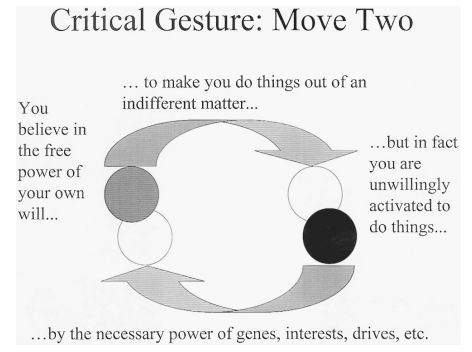
Do you see now why it feels so good to be a critical mind ? Why critique, this most ambiguous pharmakon, has become such a potent euphoric drug ? You are always right ! When naïve believers are clinging forcefully to their objects, claiming that they are made to do things because of their gods, their poetry, their cherished objects, you can turn all of those attachments into so many fetishes and humiliate all the believers by showing that it is nothing but their own projection, that you, yes you alone, can see. But as soon as naı¨ve believers are thus inflated by some belief in their own importance, in their own projective capacity, you strike them by a second uppercut and humiliate them again, this time by showing that, whatever they think, their behavior is entirely determined by the action of powerful causalities coming from objective reality they don’t see, but that you, yes you, the never sleeping critic, alone can see. Isn’t this fabulous ? Isn’t it really worth going to graduate school to study critique ? “Enter here, you poor folks. After arduousyears of reading turgid prose, you will be always right, you will never be taken in any more ; no one, no matter how powerful, will be able to accuse you of naïveté, that supreme sin, any longer ? Better equipped than Zeus himself you rule alone, striking from above with the salvo of antifetishism in one hand and the solid causality of objectivity in the other.” The only loser is the naïve believer, the great unwashed, always caught off balance.
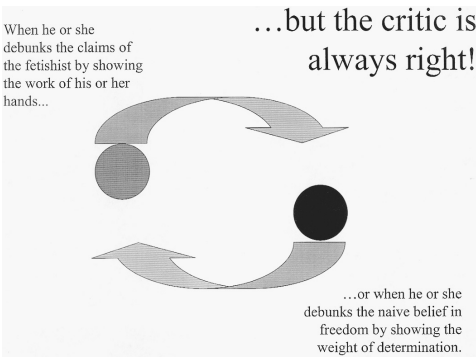
Is it so surprising, after all, that with such positions given to the object, the humanities have lost the hearts of their fellow citizens, that they had to retreat year after year, entrenching themselves always further in the narrow barracks left to them by more and more stingy deans ? The Zeus of Critique rules absolutely, to be sure, but over a desert.
24 12 25
Latour
,
« Why Has Critique Run out of Steam ? From Matters of Fact to Matters of Concern »
, Critical Inquiry n° 30
, ,
p. 237–239